Most family budgets fail for a simple reason: they are just blank pages with no teaching. A blank spreadsheet or an empty notebook hands you rows and columns but never shows you how to fill them in — what to do first, how to handle the weeks when the money runs short, or how to turn one good month into a habit. Without short lessons, worked examples, and a page that tells you what to do next, a budget is only a place to record that you are already in trouble. The workbook approach fixes this by teaching first and writing second: each short lesson explains one idea, then a write-in worksheet walks you through doing it for your own household. That is the idea behind The Family Budget Workbook — and it works even if you have never kept a budget before.
1. Start with what you actually spend
Before you plan a single dollar, find out where your money actually goes. For one month, write down everything you spend — every bill, every grocery run, every coffee. No judgment, no changes yet. Most households are surprised: it is rarely the big bills that sink the month, but the small, repeated spending nobody writes down. This is why the workbook approach starts with a real-spending worksheet instead of a wish list. Once the numbers are on paper, patterns jump out: the subscription you forgot, the drive-through habit, the bill that crept up ten dollars. Those patterns are your starting line. You cannot build a budget you will actually follow until you know the household you are budgeting for — the real one, receipts and all.
2. Give every bill a date, not just a total
A list of bills with a total at the bottom tells you what the month costs, but not when it costs it. And timing is where most budgets break. Rent on the 1st, the electric bill on the 8th, groceries spread across four weeks — the money leaves in waves, but most budgets treat it as one lump sum. Then a big bill lands before payday and the month falls apart. The workbook fix is a simple calendar page: every bill gets a name, an amount, and a due date, lined up against your paydays. You can see at a glance which weeks are heavy and which are light. On a fixed income, this matters even more, because there is no extra paycheck coming to cover a badly timed bill. Give every bill a date, and the month stops surprising you.
3. Pay debt in an order you can see
Debt feels overwhelming because it is usually one big, scary number. The workbook approach breaks it into a visible order: list every debt from smallest balance to largest, keep paying the minimums on all of them, and put every extra dollar toward the smallest one. When it is gone, roll that payment into the next smallest. This order — smallest to largest, not highest interest first — is deliberate. Wiping out a whole debt early gives you a visible win, and that win keeps you going through the bigger ones. The worksheet lays this out as a simple payoff order you can check off, month by month. You can see the list getting shorter, and that visible progress is what turns a payoff plan from a wish into a routine.
4. Plan the holidays before they plan you
The holidays are not a surprise — they come every year on the same dates — yet for most households they arrive like an ambush, and January brings the bill. The workbook approach treats the holidays as a line item like any other. Decide now what you will spend, make the list early, and put a little aside each month through the fall. A short holiday worksheet helps you name every gift, every meal, and every trip, so nothing hides off the page. When December arrives, you shop from a plan instead of a panic. There is no magic here, just the same idea as the rest of the budget: write it down before it happens, and the month — and January — belongs to you.
Frequently asked questions
Is this a paper workbook or an app?
A paper workbook — a 120-page paperback you can hold, write in, and keep on the kitchen table. No accounts, no subscriptions, no screens. The write-in worksheets are the point: you do the lessons by hand, which is exactly how the numbers stick.
Do I need budgeting experience?
None at all. Each part starts with a short, plain-English lesson that teaches one idea, then gives you a worked example and a worksheet to do it yourself. If you can add and subtract, you can do every page — the book was written for households starting from zero, including readers on fixed incomes.
Where can I get it?
It is available in paperback on Amazon for $9.99. You will find the cover and the buy link in the box below.
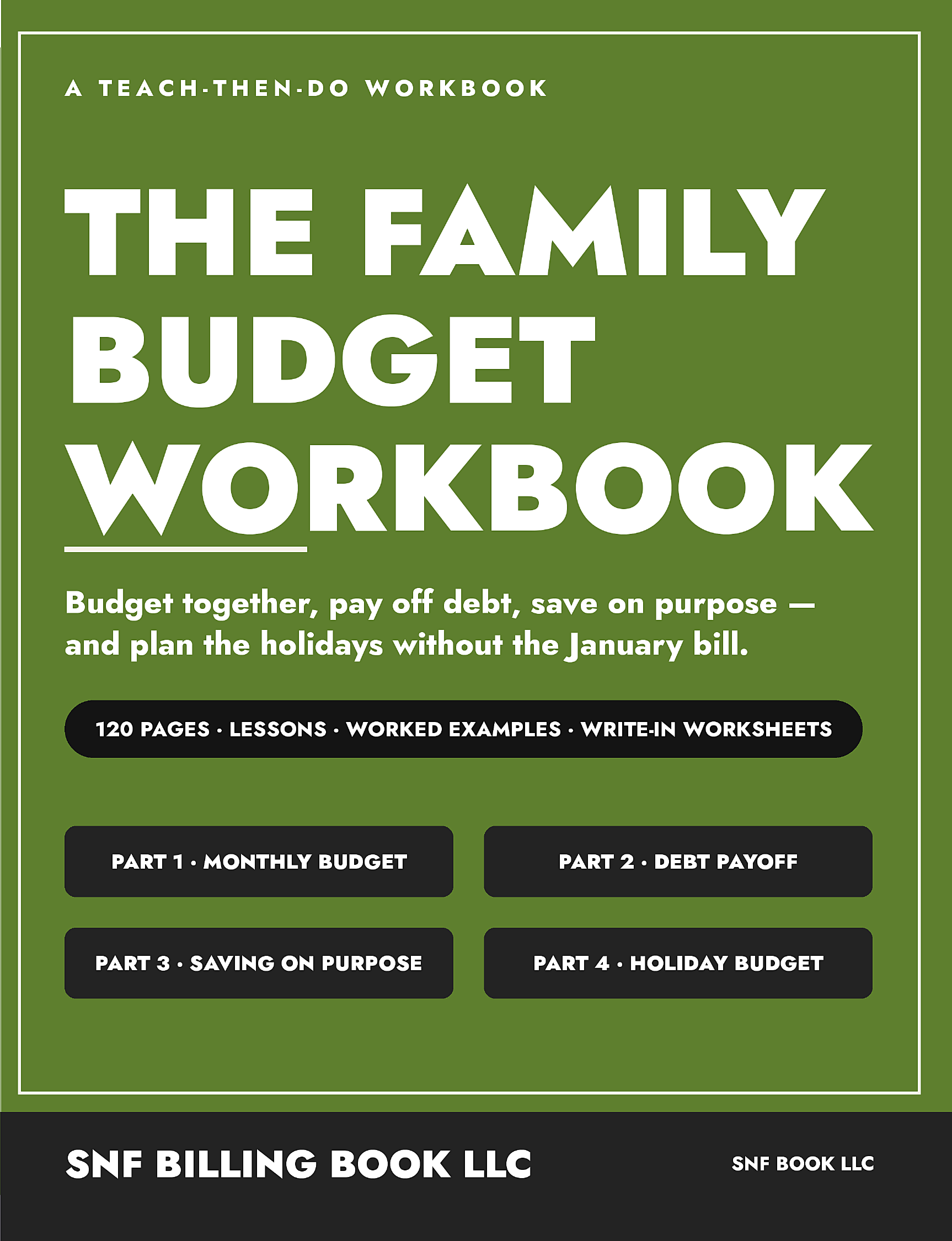
The Family Budget Workbook — short lessons, worked examples, and write-in worksheets that walk your household through a monthly budget, a debt payoff order, savings on purpose, and a holiday plan with no January bill. 120 pages, paperback.
By SNF Billing Book LLC · $9.99 on Amazon.


Leave a Reply